Today is National Day for Truth and Reconciliation 2025. This morning, I attended a ceremony at the Canadian Museum of History in Gatineau to acknowledge and reflect on the devastation of the Indian Residential School system. A local Indigenous elder began the ceremony with a prayer and a reflection. On her podium, she brought with her a little miniature canoe. The elder explained that the canoe represented the concept that all of us are in the same boat rowing together. Immediately, I remembered that I had reflected upon this idea and its connection to Filipino culture a few years ago. In recent year, I’ve been involved with a Filipino-Canadian youth organization called Kabangka — a word that means “being on the same boat.” Today, as I did two years ago, I am amazed by the parallels between Filipino cultural and psychological concepts (particularly Indigenous inspired concepts) and Indigenous concepts from Peoples on Turtle Island. The parallels in our shared experiences with colonization. I reflect on how colonization has impacted our Peoples in different ways. And I reflect on how the basic idea is the same — we are all on one boat, rowing together. Our lives are intertwined and we all have the responsibility and honour to take care of one another and to live in kapwa with one another. We are all one — one with each other, one with nature, one with the spirits, one with the past, one with the present, and one with shared futures. For Filipino-Canadians, we have a responsibility to stand in solidarity and live in kapwa with our Indigenous siblings. We have our own special role to play in Reconciliation.
Below is the an edited first draft of a blog post I just re-discovered today, which I started writing two (?) years ago. I’ve made a few changes as of September 30th, 2025.
On National Day for Truth and Reconciliation, I’m asking a few questions: What does it mean to be Filipino-Canadian? Because I’m also asking: What does Reconciliation mean for Filipino-Canadians — “us” or “tayo”?
That’s a question we — certainly I — struggle with everyday. And when I say “we” I mean “tayo”. I mean “our community”. Filipinos in Canada, who immigrated here or whose parents immigrated here or whose grandparents immigrated here or maybe even ancestors many generations ago who immigrated here. We came searching for a better life. We found it, in a place called “Canada”. But we also have yet to reckon with our own responsibilities to the Indigenous Peoples of this land as immigrant-settlers. I think it’s time we ask ourselves these questions.
It’s a fraught reflection — Filipinos have also experienced the devastation of colonialism, the beauty and resources of our islands ravaged by the Spanish, the Chinese, the Americans (and even briefly, the British). Our Indigenous roots were burned, forced to accept a new language, a new religion, a new culture that was antithetical to our ancient values and traditions. And in the past century, as Filipinos sought better lives abroad, many settled in “Canada” — on a land also ravaged by colonialism, unceded by the Indigenous Peoples who have called this land their home for centuries. This place we now call our “home and sacred land”. We Filipino-Canadians are immigrants, but we are settlers to a land that was forcefully taken from Indigenous Peoples and dominated by a society that wanted to “kill the Indian in the child.”
We are Filipino-Canadians. We owe everything to the Indigenous Peoples of this land. We have a responsibility — an “utang ng loob” — to pursuing Reconciliation.
I have questions and few answers. I write this with an open heart, willing to learn and to reflect together. I’ve only just begun learning about the Philippines history with colonialism and the crimes of our colonizers, as well as the continuing pillaging of our Bayan by global superpowers. (Update: In 2025, as I write this, Filipinos at home are rising up against a political and financial elite who are pillaging the wealth of the country, siphoning away funds that should have gone toward flood prevention, all so their nepo babies can buy new cars and purses.) I am also still learning about the violent history of Indigenous Peoples in “Canada,” about the Residential School system, about Missing and Murdered Indigenous Women, Girls, and Two-Spirited Peoples, about the overincarceration of Indigenous Peoples, about substance abuse, about intergenerational trauma, and so much more.
We have shared colonial experiences but I also want to be careful about a false and tenuous equivalence of our histories. We are not the First Nations, Inuit, or Métis of this land and I caution against simple narratives. But I hope there are lessons to be learnt from our ancestors about our shared values of interconnectedness and oneness.
In recent years, I’ve been supporting a Filipino-Canadian youth organization called Kabangka. The name of the organization is inspired by a poem by my friend Rachel Evageline Chiong. The word can be translated from Tagalog to English, as being on the same boat as someone. Rachel’s poem illustrates Filipinos wading on a boat, one as a people, floating through their history and heading towards their futures.
This morning, I attended a ceremony at the Canadian Museum of History in Gatineau for National Day for Truth and Reconciliation. A local Indigenous elder began the ceremony with a prayer and a reflection and had a little miniature canoe on her podium. The elder explained that the canoe represented the concept that all of us are in the same boat rowing together.
Filipinos and Indigenous Peoples share in this core value that we are all interconnected and our pasts, present, and futures are all intertwined. We are all in one boat. That means we all have the honour and responsibility to care for each other and row together toward our shared destiny in this one canoe/“bangka”.
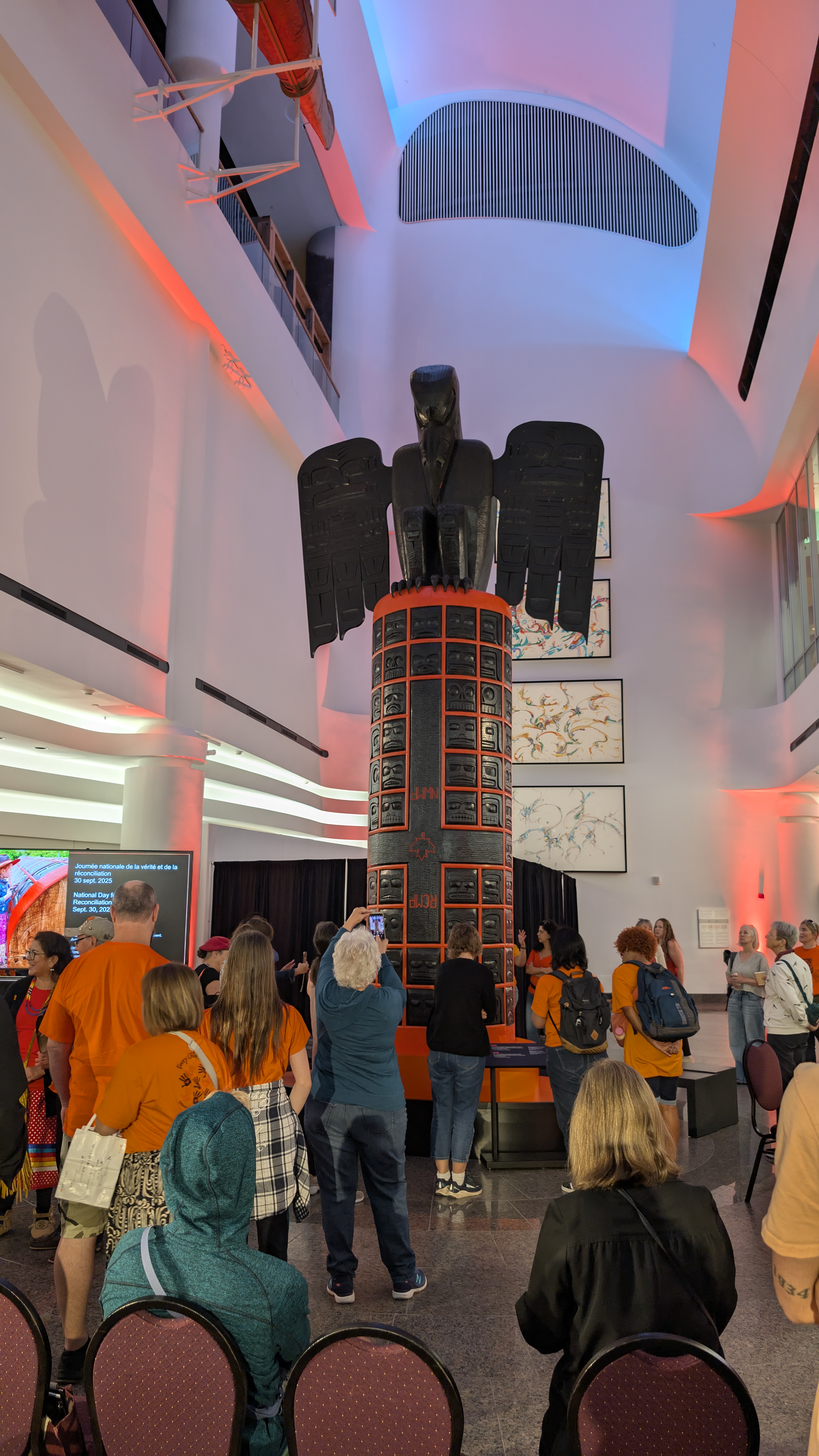
Header image: Alex Janvier’s Morning Star painting on the ceiling of the Haida Gwaii Salon at the Canadian Museum of History (Gatineau, QC)